🌿 Mold Growth & 5G: A Thoughtful, Evidence-Based Perspective
At Nash Everett, we understand that many of our clients come to us after long, difficult experiences—often feeling unheard, overwhelmed, and searching for answers that make sense of what they’re going through.
One question we’ve been asked more frequently in recent years is:
“Can 5G or wireless radiation cause mold to grow faster or become more harmful?”
This is a valid question—and it deserves a respectful, honest answer.
🧪 What Current Science Tells Us
There has been some scientific research looking at how electromagnetic fields (EMFs)—including those used in wireless technologies—interact with biological organisms, including fungi (mold).
Some laboratory studies suggest that EMFs may influence microbial behavior under certain controlled conditions. However:
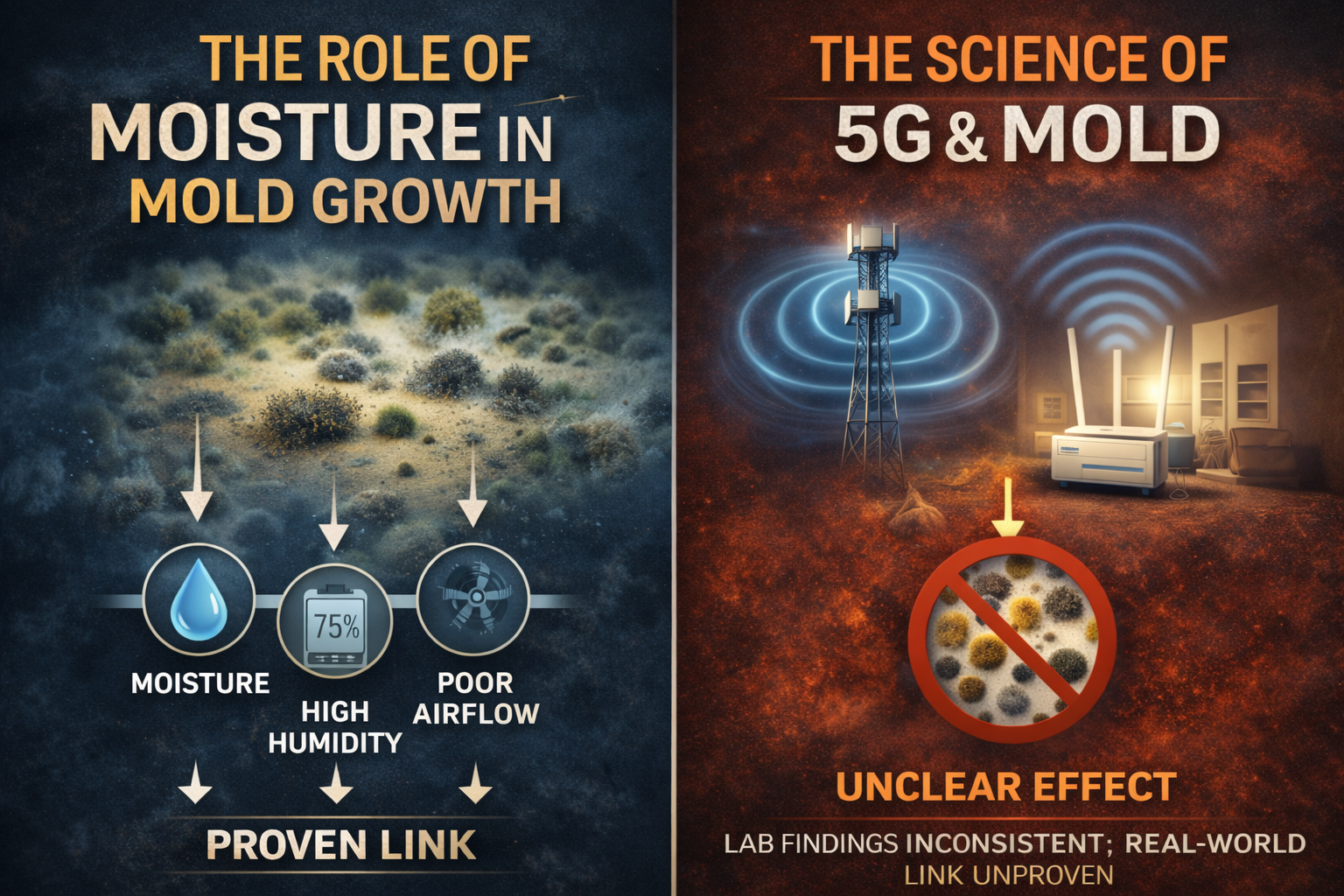
- The findings are inconsistent (some show increased activity, others show no change or even decreased growth)
- These studies are conducted in highly controlled lab environments
- The exposure levels and conditions often do not reflect real-world settings like homes or buildings
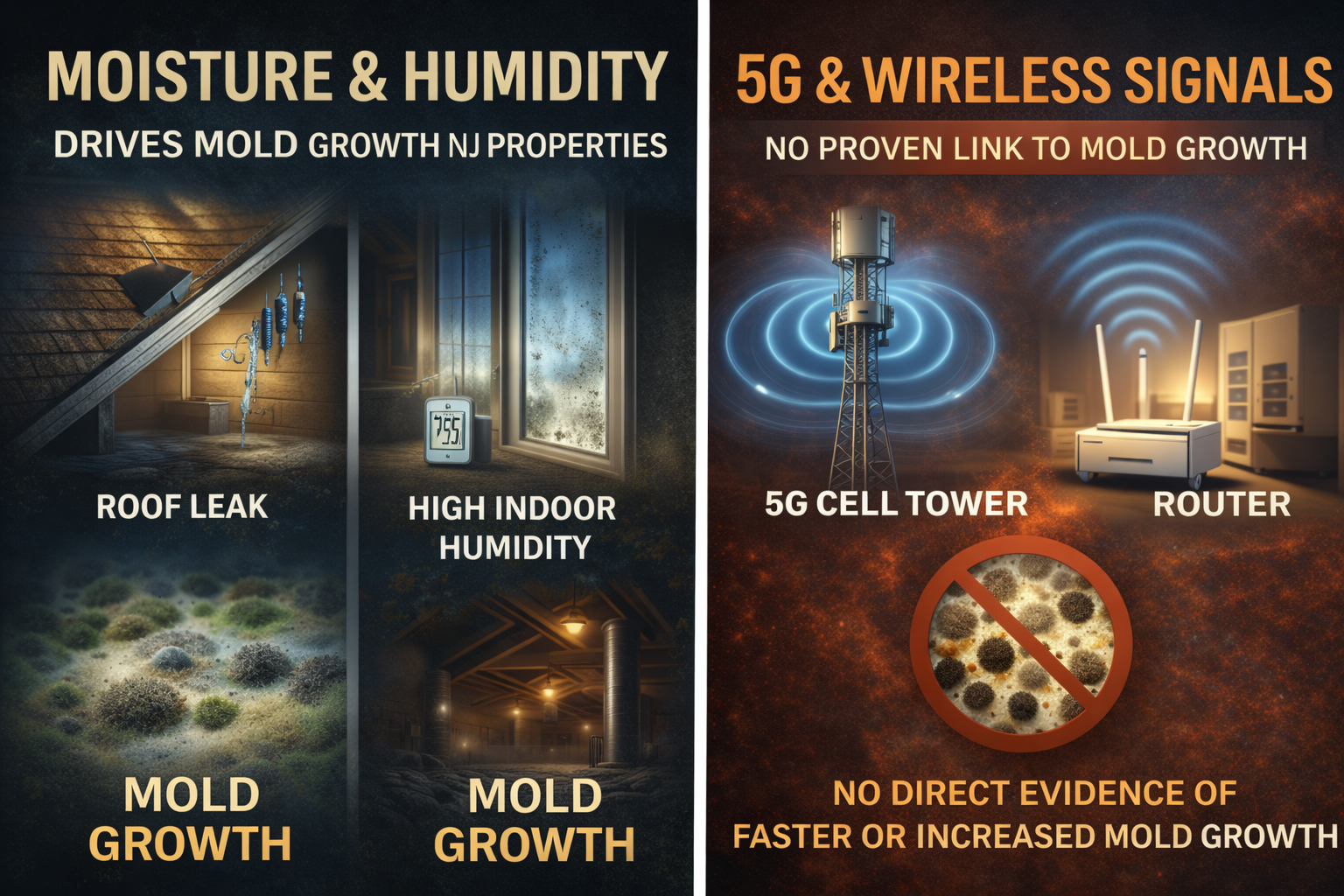
At this time, there is no strong or consistent scientific evidence showing that 5G exposure causes mold to grow faster or spread more aggressively in indoor environments.
⚖️ Why This Topic Can Feel Confusing
We understand that many people have come across information suggesting a connection between mold, electromagnetic fields (EMFs), and newer technologies like 5G. Some of these ideas are rooted in real scientific research—but the conclusions are often more complex than they appear at first glance.
There are peer-reviewed studies showing that electromagnetic fields can interact with fungi under laboratory conditions. For example:
- A 2024 study found that exposure to radiofrequency EMFs (900–1800 MHz) could either stimulate or inhibit fungal growth depending on frequency and species
- Other research has shown EMF exposure may increase enzyme activity and protein production in fungi, suggesting a measurable biological response
- Some studies on low-frequency EMFs observed increased growth rate and pathogenicity in specific fungal species under controlled conditions
At the same time, the scientific literature consistently shows the opposite can also occur:
- EMFs have been shown to reduce fungal growth, virulence, or biofilm formation under different conditions
- Reviews of the field conclude that outcomes are highly dependent on intensity, frequency, and exposure duration, with no consistent direction of effect
In other words, the science does not point to a single conclusion—it shows that fungi can respond to EMFs in different ways depending on very specific conditions.
It’s also important to note that:
- These studies are conducted in controlled laboratory environments
- Exposure levels are often higher or more direct than what occurs in homes
- There is currently no strong evidence directly linking 5G exposure to increased mold growth in real buildings
At the same time, many individuals dealing with mold-related illness are trying to make sense of complex, real symptoms. If you’ve noticed patterns in how you feel in different environments, that experience matters. Our goal is not to dismiss those observations, but to provide clarity around what is currently supported by evidence—and what is still being explored.
🏠 What We Know Does Drive Mold Growth
While research on EMFs and biology is still evolving, the environmental conditions that drive mold growth are well established and consistently supported by building science and microbiology:
- Moisture and elevated humidity
- Water intrusion (leaks, flooding, condensation)
- Poor airflow or ventilation
- Organic materials (wood, drywall, dust, insulation)
These factors create the conditions mold needs to grow, reproduce, and spread.
Even in studies where EMFs appear to influence fungal behavior, researchers emphasize that outcomes depend on controlled exposure variables—not the everyday conditions found in residential or commercial buildings.
From a practical standpoint, this means:
- Mold growth in homes is driven by moisture and building conditions, not wireless signals
- Addressing water damage, humidity, and contamination is the most reliable and effective solution
📚 References & Scientific Sources
- Applied Sciences (2024) – “Impact of Radiofrequency Electromagnetic Fields on Fungal Growth and Metabolism”
https://www.mdpi.com/2076-3417/14/24/11508 - National Center for Biotechnology Information (NCBI) – Review of EMF Effects on Microorganisms
https://pmc.ncbi.nlm.nih.gov/articles/PMC10553255/ - NCBI (2022) – Effects of Electromagnetic Radiation on Microbial Growth and Enzyme Activity
https://pmc.ncbi.nlm.nih.gov/articles/PMC9695996/ - ScienceDirect (2023) – Environmental Research on EMFs and Fungal Behavior
https://www.sciencedirect.com/science/article/abs/pii/S0048969723005545 - Journal of Environmental and Occupational Health / LWW (2025) – Do Human Electromagnetic Fields Influence Fungal Growth?
- International Telecommunication Union (ITU) – 5G, EMF, and Health Overview
https://www.itu.int/en/mediacentre/backgrounders/Pages/5G-EMF-health.aspx - European Parliament Research Service (2021) – Health Impact of 5G: Current State of Knowledge
https://www.europarl.europa.eu/RegData/etudes/STUD/2021/690021/EPRS_STU(2021)690021_EN.pdf
🔍 Our Approach at Nash Everett
We focus on what we can measure, verify, and effectively correct, including:
- Identifying hidden moisture sources
- Removing contamination at the microscopic level
- Addressing air quality and particle load (including mycotoxins)
- Improving ventilation and environmental conditions
At the same time, we respect that every client’s situation is unique. If you have concerns about environmental factors beyond mold, we’re always open to discussing them in a grounded, supportive way.
🤝 A Balanced Takeaway
- There is currently no solid evidence that 5G or wireless signals directly cause mold to grow faster in homes
- Research on EMFs and biology is ongoing and not yet definitive
- The most effective way to control mold is still through moisture control and proper remediation
If you’re dealing with mold-related concerns, you’re not alone—and you deserve clear answers and real solutions.