When it comes to controlling moisture in crawl spaces and basements, two primary strategies are often considered: mechanical ventilation and dehumidification. Each approach operates differently, and more importantly, each performs best under specific conditions. There is no universal “better” option—only the right solution for the environment at hand.
Understanding the Two Approaches
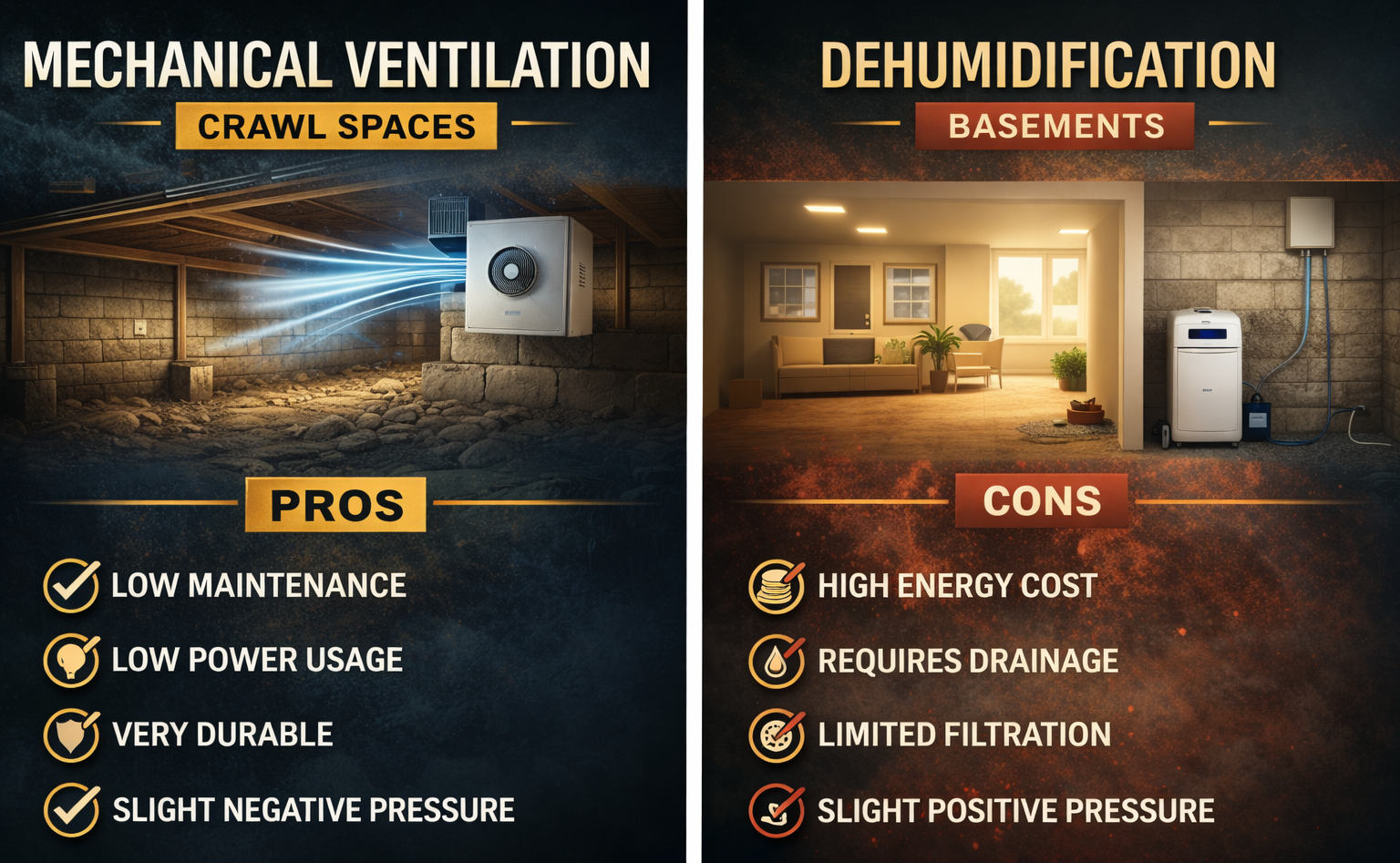
Mechanical ventilation works by exchanging air. It introduces a small amount of conditioned air—often borrowed from an already conditioned living space—while simultaneously exhausting moisture-laden air from the lower air column. These systems are typically balanced, maintaining controlled airflow and helping regulate humidity levels.
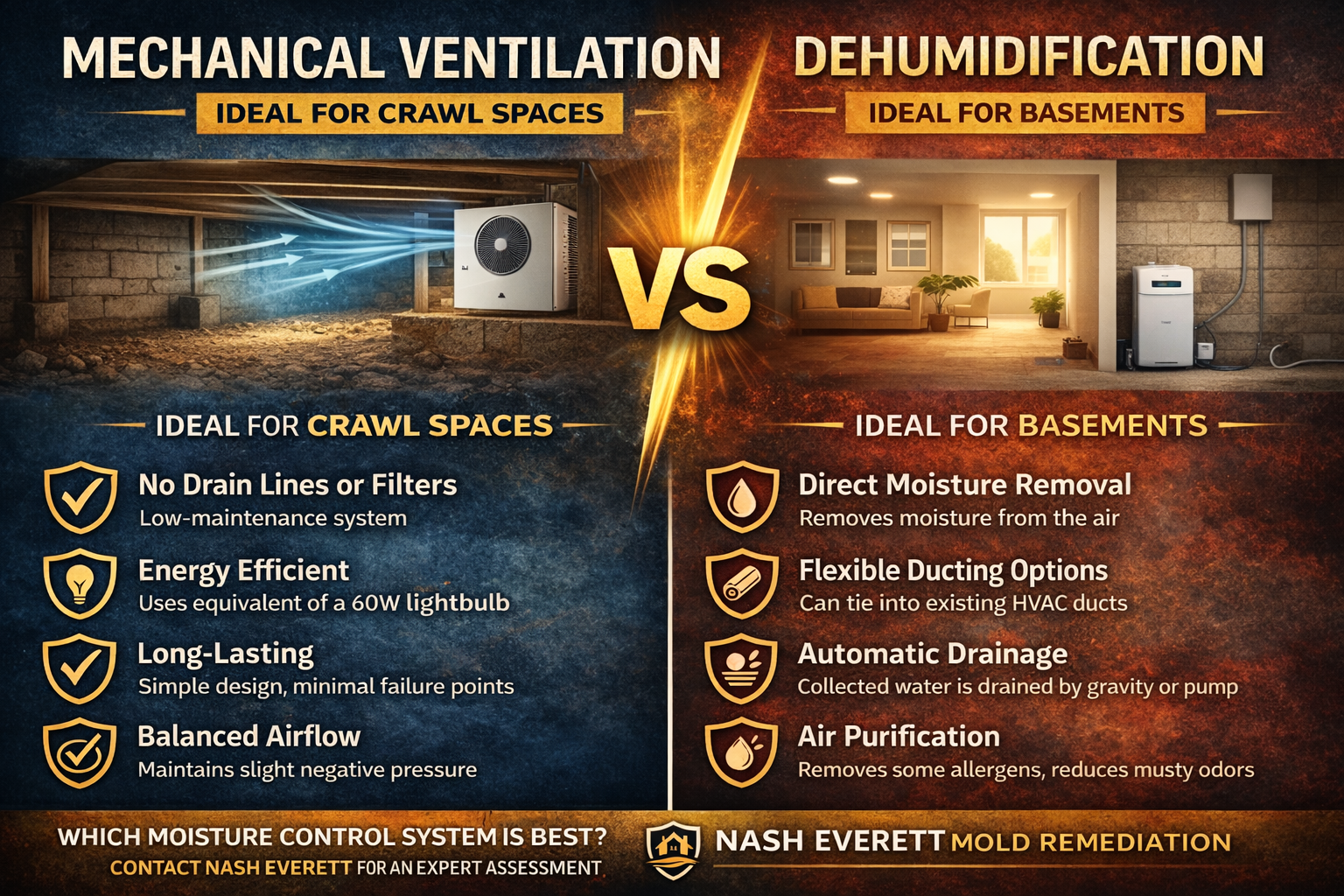
Dehumidification, on the other hand, removes moisture directly from the air. It operates through refrigeration: air is drawn over cold coils, causing moisture to condense into water droplets that are then drained away through a hose or pump system.
Where Mechanical Ventilation Excels
Crawl spaces are often ideal environments for mechanical ventilation. These areas are typically more open, with fewer barriers, and although not always the case, they tend to have lower air volume due to limited height.
In these conditions, ventilation systems offer several key advantages:
1. Low Maintenance & Accessibility
Mechanical ventilation systems are simple. They do not rely on filters or drainage systems, meaning very little ongoing maintenance is required.
2. Energy Efficiency
These systems are extremely cost-effective to operate, often using about the same amount of energy as a 60-watt light bulb.
3. Durability
Because of their straightforward design, failures are rare. It’s not uncommon to see units still running effectively after 20 years.
4. Negative Pressure Benefits (IAQ Advantage)
From an indoor air quality perspective, maintaining a slight negative pressure is a major benefit. It helps prevent contaminants, mold spores, and other pollutants from migrating into upper living spaces.
5. Air Exchange Benefits
In addition to moisture control, these systems help remove odors and even reduce gases such as radon.
Where Dehumidification Has the Advantage
While ventilation performs well in crawl spaces, basements present a different challenge.
Basements are often:
- Larger in volume
- Taller in height
- More compartmentalized
These factors make consistent air exchange much more difficult. In these environments, dehumidification becomes the more effective solution.
For best performance:
- In compartmentalized basements, dehumidifiers should ideally be tied into the HVAC system’s supply and return (when ductwork is available).
- In open basements, a centrally located unit can effectively manage humidity.
Dehumidifiers also offer flexibility through various ducting configurations, giving them a clear advantage in complex layouts.
The Drawbacks of Dehumidification
Despite their effectiveness, dehumidifiers come with trade-offs:
1. Higher Operating Costs
During peak summer months, these systems can significantly increase energy bills.
2. Water Management Requirements
Dehumidifiers generate water that must be discharged via gravity drains or pumps. This adds complexity and potential points of failure.
3. Limited Filtration
Most built-in filters are not designed to capture smaller particles, limiting their effectiveness for true air purification.
4. Positive Pressure Concerns
Dehumidifiers can create a slight positive pressure environment, potentially pushing contaminants upward into living spaces—a “balloon effect” that indoor air quality professionals must consider.
The Bottom Line
Both mechanical ventilation and dehumidification are effective tools—but only when used in the right environment.
- Crawl spaces often benefit from the simplicity, efficiency, and airflow advantages of mechanical ventilation.
- Basements, especially larger or segmented ones, typically require the targeted moisture removal that dehumidifiers provide.
There is no one-size-fits-all solution. The key factors—environment, air volume, layout, and overall conditions—must guide the decision.
That’s why it’s critical to have an experienced professional evaluate your space before committing to a system.
At Nash Everett, we specialize in identifying the right solution for your specific environment—ensuring long-term moisture control, better air quality, and peace of mind.