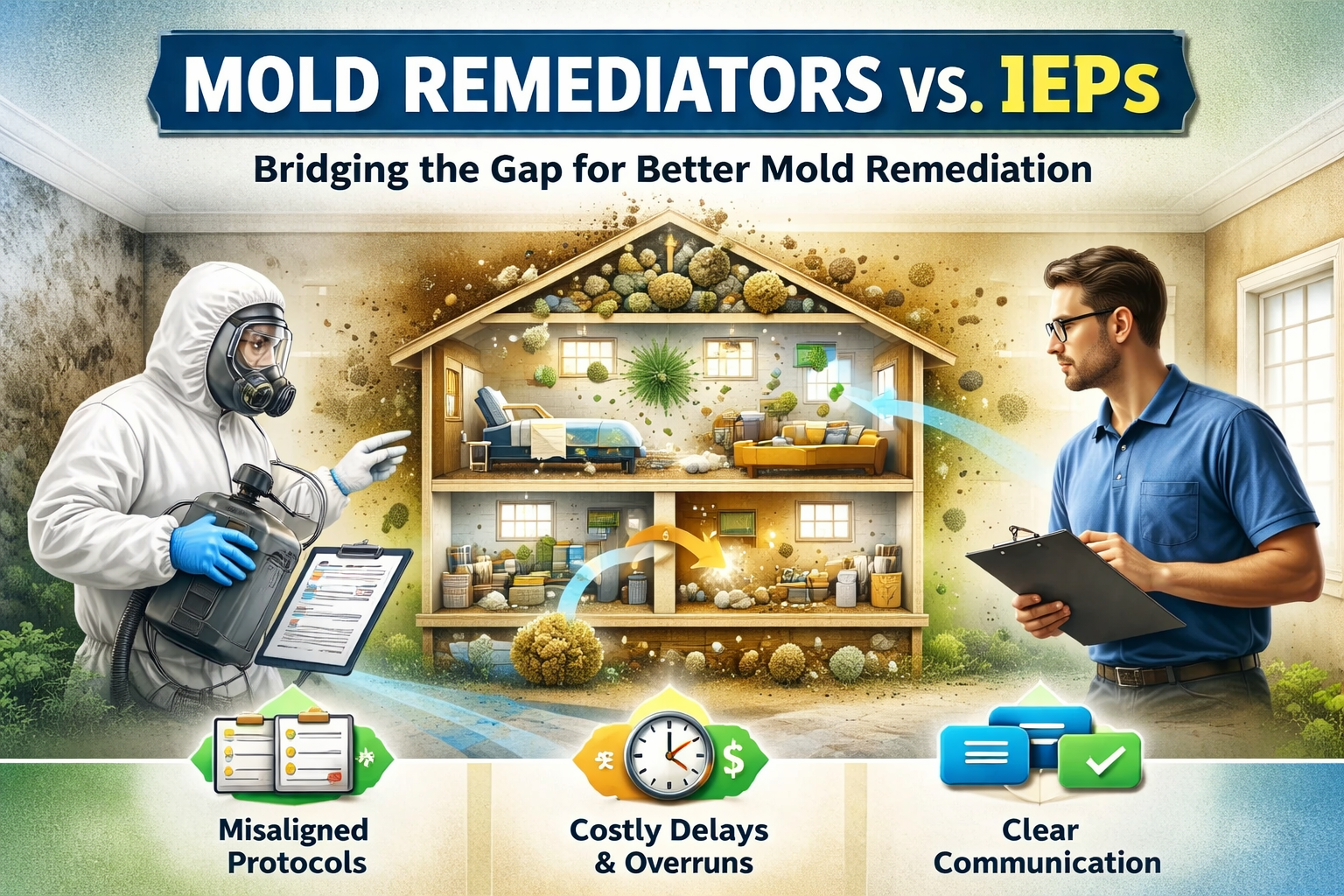
Remediators vs. IEPs? Why That Mindset Is Costing Everyone (Including the Client)
In the mold remediation industry, there’s a tension that rarely gets talked about—but almost everyone has experienced.
The relationship between remediation contractors and Indoor Environmental Professionals (IEPs) can sometimes feel adversarial. One defines the protocol. The other executes it. And somewhere in between, disagreements arise—about scope, procedures, and clearance.
But the truth is:
This isn’t a “who’s right” problem. It’s a systems problem.
The Real Issue: No Universal Standard
Unlike many trades, mold remediation operates under a standard of care, not a strict rulebook.
That means:
- Different IEPs = different protocols
- Different interpretations = different expectations
- Same job = different outcomes
None of this is wrong—but without alignment, it creates friction.
Where Projects Start to Break Down
- PRV Protocols Aren’t Defined Upfront
Should negative air be ON or OFF?
How long should the area stabilize?
What determines a pass or fail?
If these aren’t defined early, they get decided later—when it’s more expensive. - Scope vs. Responsibility Gets Blurred
Contractors execute
IEPs define and verify
But when protocols shift mid-project, scope becomes unclear—and so do costs. -
Field Reality Gets Overlooked
Every technical decision has operational impact:- Equipment runtime
- Labor hours
- Scheduling delays
- Cost to the client
These aren’t minor details—they drive the entire project.
The Real Cost of Misalignment
When expectations aren’t aligned:
- Projects take longer
- Costs increase
- Clients lose confidence
- Professionals get frustrated
And most importantly:
The client ends up paying for the disconnect.
A Better Approach
The solution isn’t more rules—it’s better coordination.
- Define PRV protocols before work begins
- Communicate operational impacts early
- Document decisions clearly
- Respect each role
Final Thought
The goal isn’t to eliminate differences.
The goal is to eliminate surprises.
Because the best projects aren’t the easiest ones—they’re the ones where everyone is aligned from the start.