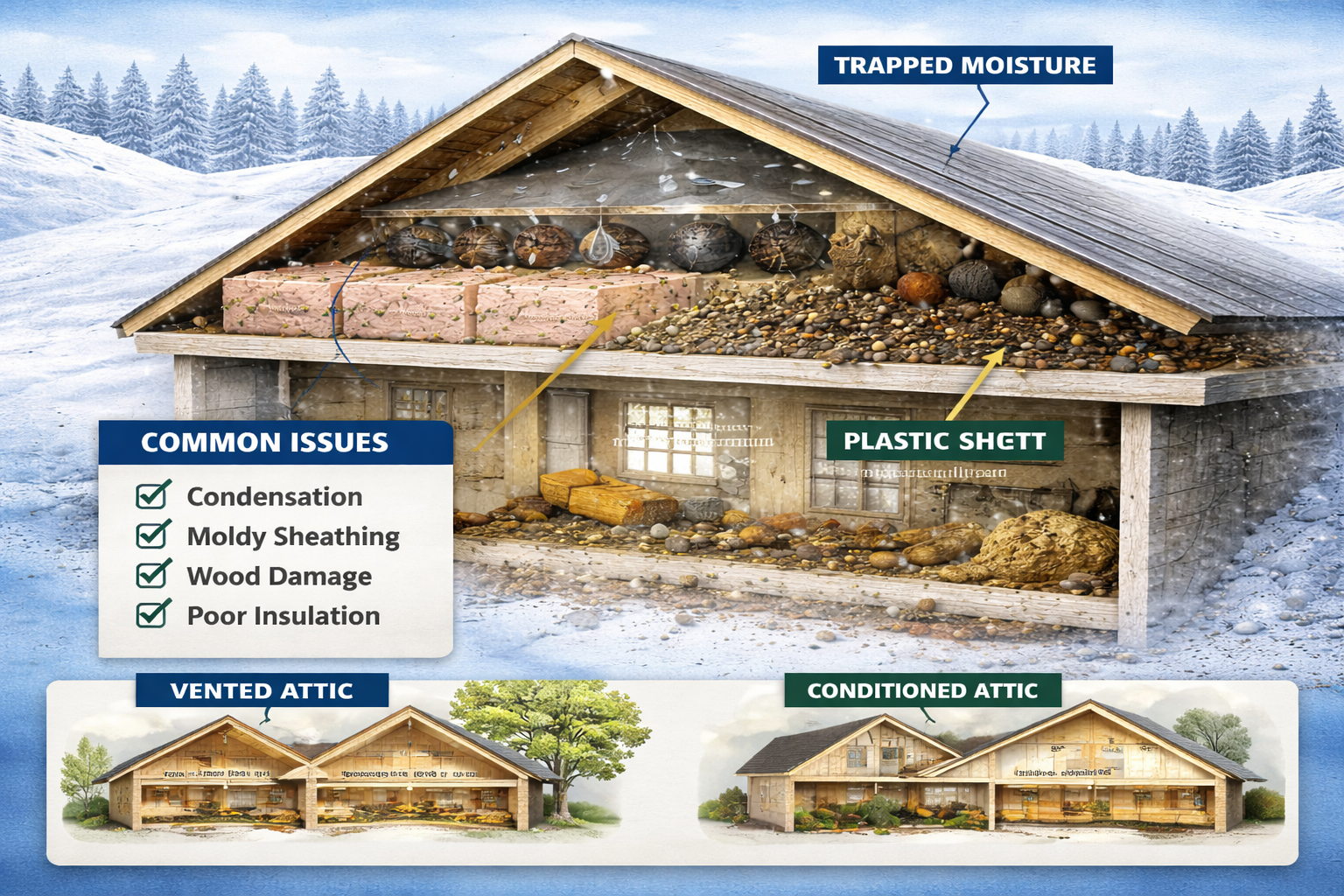
Why Adding Plastic Over Attic Insulation Can Cause Mold Problems in the Northeast
Homeowners often assume that adding more insulation—and more vapor protection—is always better.
Unfortunately, that’s not always true.
At Nash Everett, we regularly inspect homes where well-intentioned insulation upgrades have actually created the perfect conditions for mold growth.
One of the most common mistakes we see is this:
Installing kraft-faced insulation at the roofline and then covering it with 6 mil plastic.
What’s Wrong With This Setup?
At first glance, it seems logical:
- Insulation keeps heat in
- Plastic stops moisture
But building science tells a different story.
Kraft-faced insulation already includes a built-in vapor retarder. When plastic sheeting is added over it, the assembly now has two vapor barriers on the same side.
This creates a system that cannot dry properly.
How Moisture Gets Trapped
Even with plastic installed, moisture still finds a way in.
In real homes:
- Air leaks around wiring, framing, and seams
- Warm, humid air moves into the insulation cavity
- That air hits cold roof sheathing in winter
When that happens, condensation forms.
Now the moisture is stuck:
- It can’t dry outward through the roof
- It can’t dry inward because of the plastic
Over time, this leads to:
- Mold growth on roof sheathing
- Damp, ineffective insulation
- Structural wood damage
Why This Is Worse in the Northeast
In colder climates like New Jersey and the surrounding region:
- Winter temperatures make roof sheathing very cold
- Indoor humidity naturally rises
- Condensation risk is significantly higher
That’s why improper vapor barrier use is one of the leading causes of attic mold in this area.
What Should Be Done Instead?
There are two safe, proven approaches:
- Vented Attic (Most Homes)
- Insulation is installed on the attic floor
- The attic itself is ventilated
- Moisture is allowed to escape naturally
- Conditioned Attic (Advanced Design)
- Insulation is applied directly to the roof deck using spray foam
- This creates an air seal and controls moisture properly
- No interior plastic is used
The Bottom Line
Adding plastic over kraft-faced insulation at the roofline does not improve performance—it increases the risk of moisture problems.
In building science, assemblies need the ability to dry. When you trap moisture, mold is often the result.
Concerned About Mold or Attic Conditions?
If you’ve had insulation work done recently or are noticing musty odors, it’s worth taking a closer look.
At Nash Everett, we specialize in identifying hidden moisture issues and correcting the root cause—not just treating the symptoms.
Final Thought
More insulation isn’t always better.
Better design is.