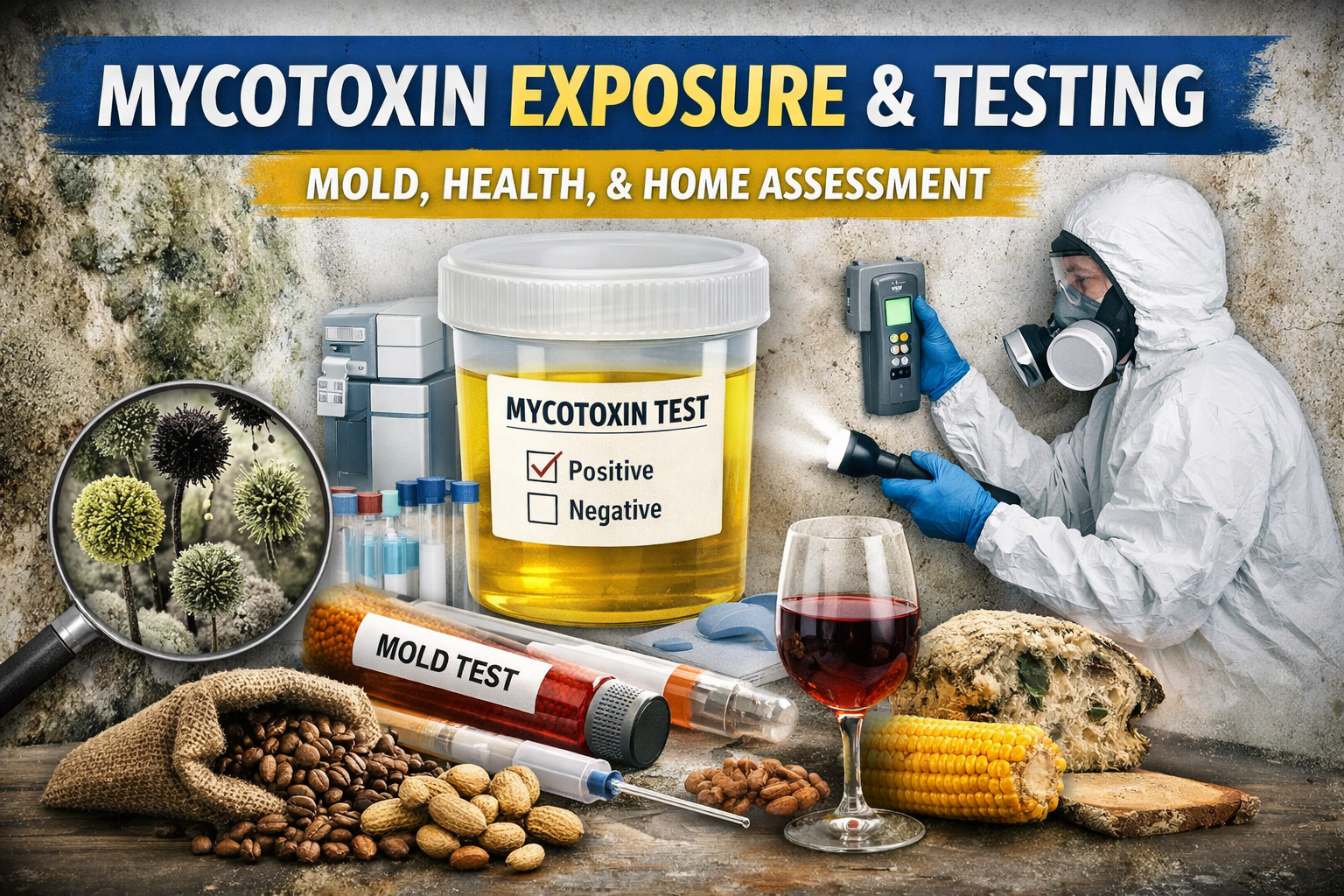
If you’ve been exposed to a water-damaged building and are experiencing unexplained symptoms, you’ve probably come across urine mycotoxin testing. Many people are told this test can confirm “mold illness” or prove their home is making them sick.
The reality is more nuanced.
At Nash Everett, we believe in combining building science, environmental investigation, and medical awareness—not relying on a single lab result. This guide explains what mycotoxins are, what urine testing can (and cannot) tell you, and how to determine whether your environment is truly the source of exposure.
What Are Mycotoxins?
Mycotoxins are toxic secondary metabolites produced by certain molds under specific environmental conditions—typically when moisture, temperature, and nutrients allow sustained fungal growth.
Common mycotoxin-producing molds include:
- Aspergillus
- Penicillium
- Stachybotrys
- Chaetomium
- Fusarium
These molds may grow in water-damaged building materials, but it’s critical to understand:
👉 Not all molds produce mycotoxins
👉 Even toxin-producing molds don’t always produce toxins indoors
Mycotoxin production depends on very specific environmental conditions, not just the presence of mold.
What Is Urine Mycotoxin Testing?
Urine mycotoxin testing measures mycotoxins or their metabolites being excreted from the body.
Common labs offering these panels include:
- Mosaic Diagnostics (MycoTOX Profile – LC-MS/MS)
- RealTime Laboratories (ELISA-based panel)
- Vibrant Wellness (Urine Mycotoxin Panel)
Common Mycotoxins Tested
Most panels include some combination of:
- Aflatoxins (AFM1)
- Ochratoxin A
- Trichothecenes (e.g., roridin E, verrucarin A)
- Zearalenone
- Gliotoxin
- Chaetoglobosin
- Citrinin
- Sterigmatocystin
- Mycophenolic acid
- Enniatins
Can a Urine Mycotoxin Test Diagnose Mold Illness?
Short answer: No.
There is currently no single test that can confirm mold illness—including urine mycotoxin testing.
Why?
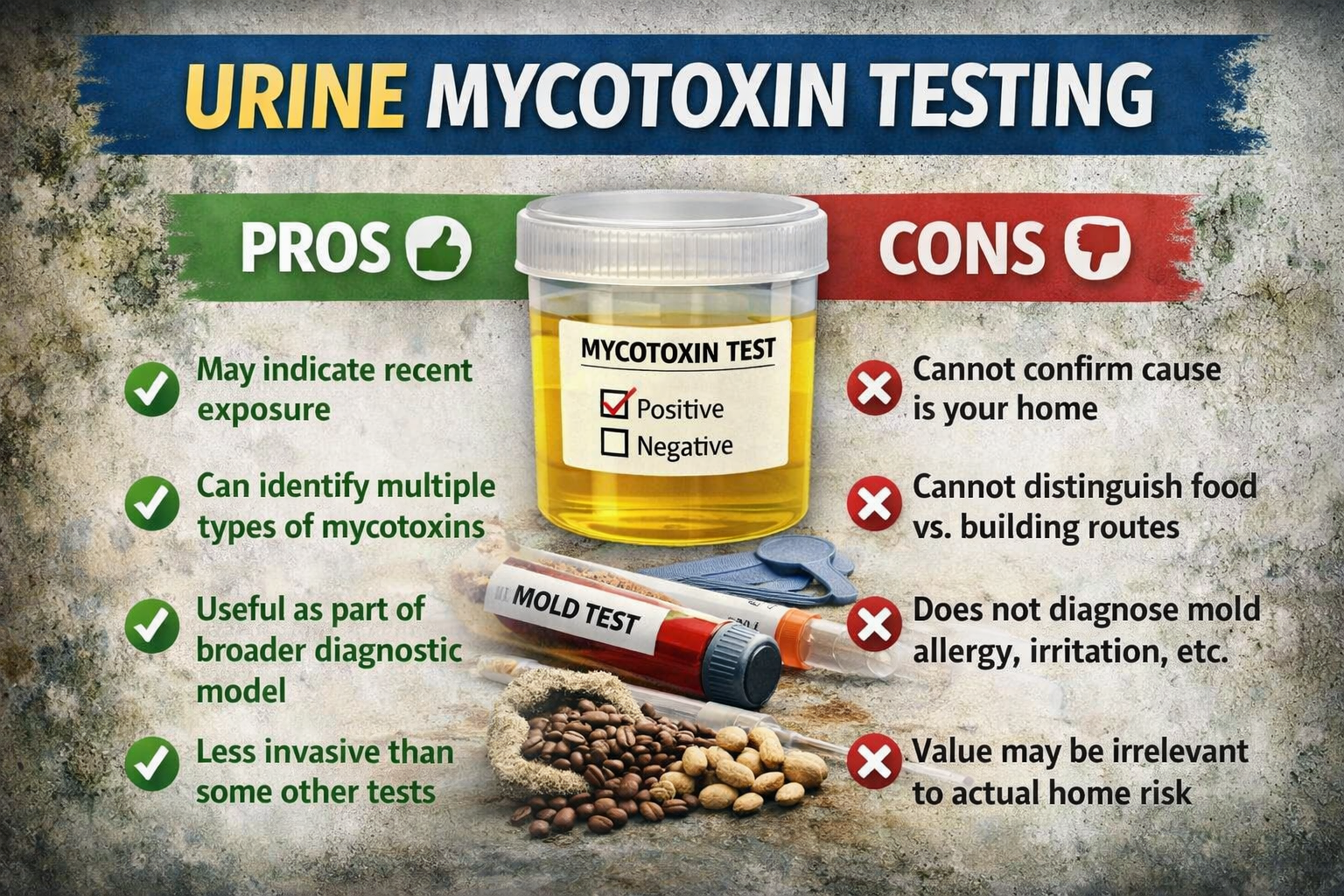
Because a positive result does NOT tell you:
- Where the exposure came from
- Whether the level is clinically significant
- Whether it is causing symptoms
- Whether exposure is current or past
The Centers for Disease Control and Prevention has stated that:
- Urine mycotoxin tests are not FDA-approved for diagnostic use
- Reference ranges for disease are not established
- Mycotoxins are commonly found in food sources, meaning even healthy individuals may test positive
The Biggest Overlooked Factor: Food Exposure
Many mycotoxins are dietary—not environmental.
Common food sources include:
- Coffee
- Grains (wheat, corn, rice)
- Nuts and seeds
- Dried fruit
- Wine and beer
- Spices
- Chocolate
For example:
- Ochratoxin A → often linked to coffee and grains
- Aflatoxins → associated with peanuts, corn, and animal products
- Fusarium toxins → common in agricultural crops
👉 This means a urine test may reflect what you ate last week—not what’s in your walls.
Strengths of Urine Mycotoxin Testing
When used properly, urine testing can still provide value:
1. Non-invasive
Simple collection compared to blood or tissue testing.
2. Indicates internal exposure
Shows that toxins entered the body—not just that mold exists in a building.
3. Can support broader investigation
Useful when combined with:
- Symptom patterns
- Environmental findings
- Medical evaluation
Limitations of Urine Testing
This is where most people get misled.
❌ Cannot identify the source
Food, environment, or past exposure all look the same.
❌ No established “danger levels”
A high result does not equal illness.
❌ Varies by lab method
- LC-MS/MS vs ELISA produce different reliability profiles
❌ Does not diagnose illness
Only shows excretion—not impact.
Comparing Mycotoxin Testing to Blood & Allergy Testing
IgE Testing (Allergy Testing)
Used to determine if your immune system reacts to mold.
- Clinically accepted
- Useful for asthma, sinus, and allergy symptoms
- Does NOT measure toxins
Supported by American Academy of Allergy, Asthma & Immunology
IgG Testing
- Sometimes used in specific conditions like hypersensitivity pneumonitis
- Often misused as a general “exposure test”
- Not reliable for identifying source or timing
Mycotoxin Antibody Testing
- Not scientifically validated
- Not recommended for diagnosis
Can You Match Mycotoxins to Mold in a Home?
This is where things get interesting—and where we can be both scientific and strategic.
Theoretical Cross-Referencing
| Mold Type | Possible Mycotoxins |
|---|---|
| Aspergillus | Aflatoxin, Gliotoxin, Ochratoxin |
| Penicillium | Ochratoxin, Citrinin, Mycophenolic Acid |
| Stachybotrys | Macrocyclic Trichothecenes |
| Chaetomium | Chaetoglobosins |
| Fusarium | Zearalenone, Enniatins |
The Problem
👉 Mold presence ≠ toxin production
👉 Toxin in urine ≠ source in home
The Smarter Approach (Nash Everett Method)
Instead of guessing, we use a multi-layered investigation model:
How to Actually Determine If Your Home Is Making You Sick
1. Moisture Mapping
Identify:
- Leaks
- Humidity issues
- Condensation zones
- Crawlspace and attic conditions
2. Building Failure Analysis
We look for:
- Water-damaged materials
- Hidden cavity contamination
- Poor ventilation
- Airflow pathways
3. Mold Ecology Assessment
Not just “what’s in the air”—but:
- Where it’s growing
- Why it’s growing
- How it’s spreading
4. Symptom Pattern Correlation
Key questions:
- Do symptoms improve away from the home?
- Do they worsen in specific rooms?
5. Cross-Referencing (Used Carefully)
We compare:
- Mold types present
- Possible toxin profiles
- Lifestyle + diet exposure
👉 Not to prove—but to build probability
Why Environmental Investigation Matters More Than a Lab Test
According to the National Institute for Occupational Safety and Health:
- Visual inspection
- Moisture detection
- Odor identification
are often more reliable than air or lab testing alone.
That’s why at Nash Everett, we focus on finding and fixing the source—not chasing numbers.
Final Thoughts
Urine mycotoxin testing is not useless—but it is often misused and overinterpreted.
The truth is:
- It can suggest exposure
- It cannot confirm illness
- It cannot identify your home as the source
The most reliable path forward is a combined approach:
✔ Building science
✔ Moisture detection
✔ Targeted environmental assessment
✔ Medical evaluation when needed
That’s how you move from confusion to clarity—and from exposure to resolution.
Work With Nash Everett
If you suspect your home or building is contributing to health issues, we specialize in:
- Mold remediation
- Crawl space encapsulation
- Attic and ventilation corrections
- Post-remediation fine particle cleaning
- Moisture and building diagnostics
Serving New Jersey with a focus on real answers—not guesswork.
References
- Centers for Disease Control and Prevention. Notes from the Field: Use of Unvalidated Urine Mycotoxin Tests for the Clinical Diagnosis of Illness.
- Centers for Disease Control and Prevention. Mold Testing and Remediation Guidance.
- American Academy of Allergy, Asthma & Immunology. Mold Allergy & Position Papers on Mold Exposure.
- World Health Organization / International Agency for Research on Cancer. Aflatoxin Biomarkers and Health Effects.
- European Food Safety Authority. Risk assessments on mycotoxins in food supply.
- Mosaic Diagnostics. MycoTOX Profile Overview.
- RealTime Laboratories. Mycotoxin Testing Information.
- Vibrant Wellness. Urine Mycotoxin Panel Overview.